IRAN vs IRAQ COMPARISON
INTRODUCTION
 |
| Flag of Iran |
 |
| Flag of Iraq |
Among
many citizens of the United States, Iran and Iraq have been grouped together
and thought of as nearly the same thing.
Some people could not even tell you the simple differences between the
two nations, or identify which one is which on a map if their life depended on
it. This likely has to do with
their similar names, similar climate, similar location or just the American
people having a general lack of geographical knowledge.
That being said, although Iran and Iraq
do have certain similarities, they are extremely different from each other in
many ways. Through
the use of the five themes of geography: location, place, human-environment
interaction, movement and region, the similarities and differences between Iran
and Iraq will become evident, with there perhaps being more differences than
people would have originally thought.
LOCATION
Iran and Iraq are both located in the Middle East in Asia where the two nations are located directly next to each other, with Iran located to the right and Iraq to the left as shown here:

Iran
is bordered by a total of seven countries, including Iraq, Turkey, Armenia,
Azerbaijan, Turkmenistan, Afghanistan, and Pakistan. Conversely, Iraq is bordered by six countries, including
Iran, Turkey, Syria, Jordan, Saudi Arabia, and Kuwait. Also shown on the map is both of the
nation’s capitals, with Tehran being Iran’s capital and Baghdad being Iraq’s
capital. Relative to each nation,
Tehran is located in the Northern central section of Iran where the latitude
and longitude coordinates are 35.715298 and 51.404343. Alternatively, Baghdad is located
slightly eastward relative to the direct center of Iraq, as well as being
located 432 miles South West of Tehran.
Baghdad has latitude and longitude coordinates of 33.312805, 44.361488. Overall, Iran and Iraq occupy locations
that are directly next to each other, and share similarities in some of the
countries they border, although, many more differences as well as more
similarities will be found when highlighting “place” between the two nations.
PLACE
Regarding physical characteristics, Iran and Iraq share many commonalities. The climate that is experienced by the native Iranian and Iraqi people is relatively similar. Both Iran and Iraq have a hot, dry climate where summer extends for a long time followed by a short winter. Both nations are influenced by the subtropical aridity of the Arabian Desert areas contributing to the dryness, but also get some humidity as well. The humidity in Iran is influenced by the subtropical humidity of the eastern Mediterranean area while the humidity in Iraq is influenced by the subtropical humidity of the southern Persian Gulf. Both nations experience January as their coldest month on average with the temperature typically being 5°C to 10°C, and August is the hottest month at 20°C to 30°C. Although, it is perfectly possible that this high number can reach even higher, possibly going up to 40°C, where threats of heat exhaustion come into play. That being said, the terrain and topography of Iran and Iraq is quite different.
In Iran, you will see many more mountains with many cities
located at a higher altitude, and a smaller amount of flat plains, as shown
here:

Alternatively, Iraq’s terrain is the
opposite, exhibiting much fewer mountains and much more broad plains, as shown
here:

Regarding human characteristics, and more specifically, population, Iran and Iraq could not be more different. Iran has roughly twice the amount of people that Iraq does, where Iran has a total population of 82,021,564 (July 2017 est.) and Iraq has a population of 39,192,111 (July 2017 est.). Iran and Iraq currently have the 18th and 36th highest population in the world. In Iran, the distribution of the population by age and gender is shown here according to Index Mundi:
0-14 years: 24.19%
(male 10,154,424/female 9,690,512)
15-24 years: 14.69%
(male 6,174,435/female 5,878,475)
25-54 years: 48.57% (male 20,316,773/female 19,522,673)
55-64 years: 7.22% (male 2,920,111/female 2,999,525)
65 years and over: 5.32% (male 2,026,594/female 2,338,042)
25-54 years: 48.57% (male 20,316,773/female 19,522,673)
55-64 years: 7.22% (male 2,920,111/female 2,999,525)
65 years and over: 5.32% (male 2,026,594/female 2,338,042)
Compared to the Iran’s population distribution, Iraq has a
higher percentage of people aged 0-24 and a lower percentage of people aged 55
and over. Iraq’s population
distribution can be seen here according to Index Mundi:
0-14 years: 39.46%
(male 7,895,522/female 7,569,205)
15-24 years: 19.25% (male 3,841,375/female 3,702,187)
25-54 years: 33.84% (male 6,704,201/female 6,558,108)
55-64 years: 3.99% (male 752,598/female 812,683)
65 years and over: 3.46% (male 601,937/female 754,295) (2017 est.)
15-24 years: 19.25% (male 3,841,375/female 3,702,187)
25-54 years: 33.84% (male 6,704,201/female 6,558,108)
55-64 years: 3.99% (male 752,598/female 812,683)
65 years and over: 3.46% (male 601,937/female 754,295) (2017 est.)
As evidenced by these charts, the median age in Iraq is far less than Iran, with the median age being 20 years (19.8 for males and 20.3 for females) in Iraq and 30.3 years (30 for males and 30.5 for females) in Iran. Judging by these statistics,
one could assume that the population growth rate would be higher in Iraq than
with Iran, which is absolutely the case.
The population growth rate in Iraq is 2.55% while in Iran it is 1.24%,
roughly half of Iraq’s percentage.
Additionally, the crude birth and death rates for Iran and Iraq also
show some differences. Iran has a
birth rate as of 2017 of 17.9 births/1,000 and a death rate of 5.3
deaths/1,000. Comparing to Iran,
Iraq has a crude birth rate of 30.4 births/1,000 and a death rate of 3.8
deaths/1,000. Both nation’s are
experiencing population growth, and are projected to keep doing so in the
future, especially Iraq. Although,
on a bleaker note, despite Iraq having a higher birth rate and a lower death
rate, they have a significantly higher infant mortality rate at 37.5
deaths/1,000 compared to Iran’s infant mortality rate at 15.9
deaths/1,000. There are many
factors that can influence these various rates, including biological, social,
economic, political, and cultural factors, and lots of the time, and in Iran
and Iraq’s case, it is a combination of all of these. Another major aspect of the population distribution in Iran
and Iraq revolves around religion.
Unsurprisingly, Iran and Iraq are dominated by Muslims, but they are
also a couple of the only nations to have a predominately Shia Muslim culture.
Iran’s population is 99.4% Muslim consisting of 90-95% Shia and 5-10% Sunni)
(2011 est.), just like Iran, Iraq has a Shia dominant culture with Shia’s occupying
64%-69% of the Muslim population (where Muslims occupy 95%-98% of the total
population) (2015 est.). This is a
rare occurrence, with Azerbaijan and Bahrain being the only two other nations
with a Shia dominated Muslim culture, and in both Iran and Iraq, it has caused
some uprisings among the Sunni culture in their search for better treatment by
the Shia dominated nations. Lastly
regarding population distribution, in both Iran and Iraq, the population is
densely concentrated in the capital cities.
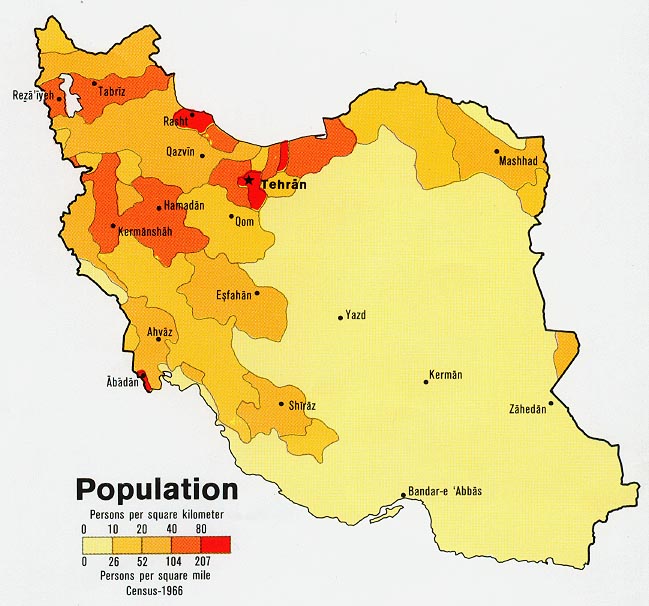
Here is a map showing Iran’s population
density:

As expected, the population is very dense in Tehran, but it is also very dense toward the whole northern third of the nation and not so much in the bottom area of Iran. This has to do with the harsh climate in the southern part of Iran that is made up of a vast desert.
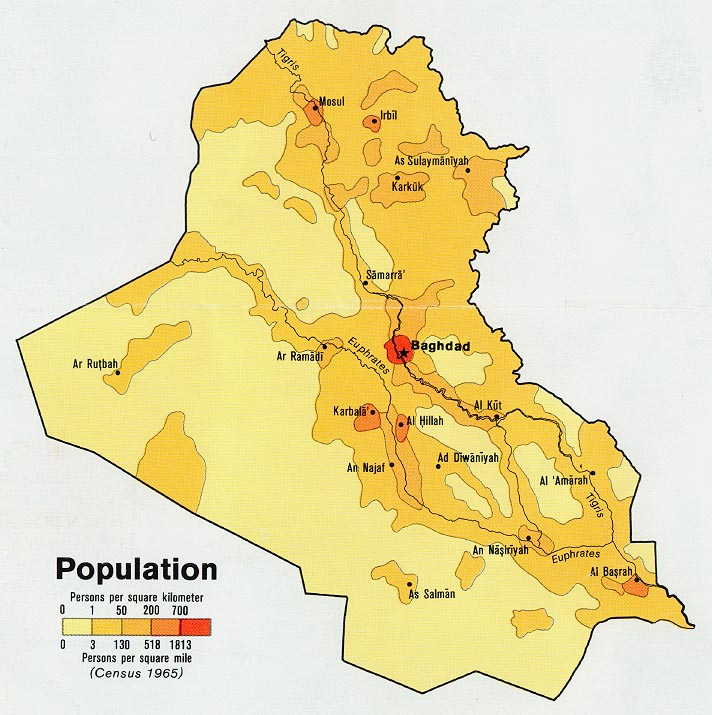
Similarly, in Iraq, the population is
centered in the capital, as seen here:

In
total, there are countless similarities and many differences as well between
Iran and Iraq regarding physical and human characteristics, and place as a
whole.
HUMAN-ENVIRONMENT INTERACTION
The way the Iranian and
Iraqi people interact with their environment is another interesting factor
regarding the two populations separate yet similar ways of life. Due to human activity, the environment
in Iran has been continuously changing for the past several decades. Vehicle emissions and the lack of
vehicle emission control devices have played a huge role in the increased
levels of pollution in and around the most populated sections of Iran,
including the capital Tehran.
Tehran is now one of the most polluted cities in the world. This increase in pollution has caused a
rising number of respiratory illnesses in Iran, which has prompted the
government of Tehran to install antipollution initiatives, aiming to slowly
decrease the amount of toxic waste released into the environment. Iran also deals with pollution coming
from their many oil refineries and wastewater runoff that pollutes the
water. Iran has attempted to
develop a system with their industries that are built for short-term riches,
but have ignored the factor of sustainability with the environment. In this regard, Iraq is quite similar
to Iran, as they deal with their own environmental problems revolved around oil
refineries and wastewater runoff.
Although, Iran has to endure a much larger scale of pollution, likely
caused by their significantly larger population, which threatens the health of
the people. In both Iran and Iraq,
the significant dryness and lack of water has also been a cause for concern,
especially since some of the water actually available has been
contaminated. In order to combat
this, Iraq and Iran have both installed desalination plants (converting salt
water into fresh, drinking water) in various areas across their respective
nations, and Iran is planning on building their biggest desalination plant yet. Desalination plants are
key for any society or nation that is lacking in water, that has access to the
ocean. Desalination plants are
becoming more and more common around the world, especially in the Middle East,
which is occupied by lots of dry desert with little water. This shows Iran and Iraq’s ability to
adapt efficiently to their climate in order to fulfill the basic needs of their
people.
MOVEMENT
There are a couple of
different types of movement that apply to Iran, Iraq and any other nation, with
the first one being the movement of humans. Immigration (moving into a country) and emigration (leaving
a country) are two very important factors to take into account that contribute
to the net migration rate when comparing Iran and Iraq. In Iran’s case, according to Index Mundi, their net migration rate -0.2 migrants/1,000 population (2017 est.)
while with Iraq, their net migration rate is -1.2 migrants/1,000 population
(2017 est.). This means with both
nations, more people are leaving Iran and Iraq than are coming in. This suggests that their populations
are in decline, but there are many other factors to be taken into consideration
when seeing if a population is increasing or decreasing, like the crude birth
and death rates, which are mentioned above. An additional type of movement is the movement of goods, and
what type of goods Iran and Iraq are exporting. According to Index Mundi, Iran’s biggest export by far is
petroleum, which accounts for 80% of their exports. Their other exports include chemical and petrochemical
products, fruits and nuts, carpets, cement and ore. In 2017, Iran made $91.99 billion through exports, which
significantly trumps the $56.74 billion Iraq made in the same year. Iraq’s main export is crude oil, which
accounts for a staggering 99% of their exports. Exports play a major role in the GDP (Gross Domestic
Product) growth rate, and Iran and Iraq experience some major differences in
this category as well. In 2017,
Iran had a GDP real growth rate 3.5% compared to Iraq, who were at -0.4%.
Overall, Iran and Iraq contrast each other regarding GDP, migration, and goods
exported.
REGION
Lastly,
region is the final major form of geography that I will use to compare and
contrast Iran and Iraq. Iran and
Iraq are universally known to be located in the same region, called the Middle
East. The Middle East is one of
the most well known regions in the world, and is defined by certain specific
characteristics. One of these
characteristics is climate, which is described above. For the most part, the Middle East is largely made up of
dry, hot desert. This region
experiences relatively long summers followed up by shorter winters. These are characteristics that both
Iran and Iraq share.
 |
| Islamic Symbol |
Another
characteristic that the Middle East possesses is that the grand majority of the
population practices Islam, which is the case in Iran and Iraq as well. Another defining characteristic of the
Middle East is the general political instability, especially in recent
times. Between terrorist
organizations, overly power hungry leaders, and constant fighting, the Middle
East has been labeled a dangerous place that people should stay away from
visiting.
CONCLUSION
REFERENCES
“Baghdad, Iraq.” LatLong.net, https://www.latlong.net/place/baghdad-iraq-12885.html. Accessed 21 April
2019
“Distance
from Tehran to Baghdad.” DistanceFromTo, https://www.distancefromto.net/distance-from-tehran-to-baghdad-iq. Accessed
20 April 2019
“Iran
to Open Largest Desalination Plant.” MSN, http://www.msn.com/en-xl/middleeast/top-stories/iran-to-open-largest-desalination-plant/ar-BBQNZrd?li=BBKxLGA&ocid=iehp. Accessed 24 April 2019.
“Iran
vs Iraq.” Index Mundi, https://www.indexmundi.com/factbook/compare/iran.iraq. Accessed 21 April
2019.
“Iran.”
Weather Online, https://www.weatheronline.co.uk/reports/climate/Iran.htm. Accessed 22 April
2019.
“Iraq.”
Weather Online, https://www.weatheronline.co.uk/reports/climate/Iraq.htm. Accessed 22 April
2019.
PHOTOS
“iran-iraq-map.”
Leader Development & Education for
Sustained Peace Program, https://ldesp.wordpress.com/2013/05/23/in reviewiransupcomingpresidential-elections/iran-iraq-map/
“Iran
Topography.” Wikipedia Commons, https://commons.wikimedia.org/wiki/File:Iran_Topography.png
“Topographic
Map of Iraq.” Pinterest, https://www.pinterest.com/pin/510877151475441567/